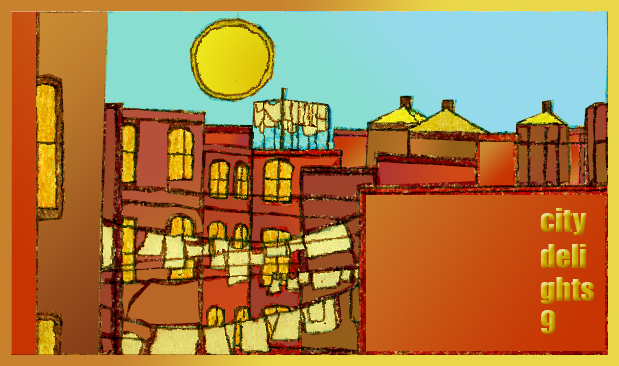
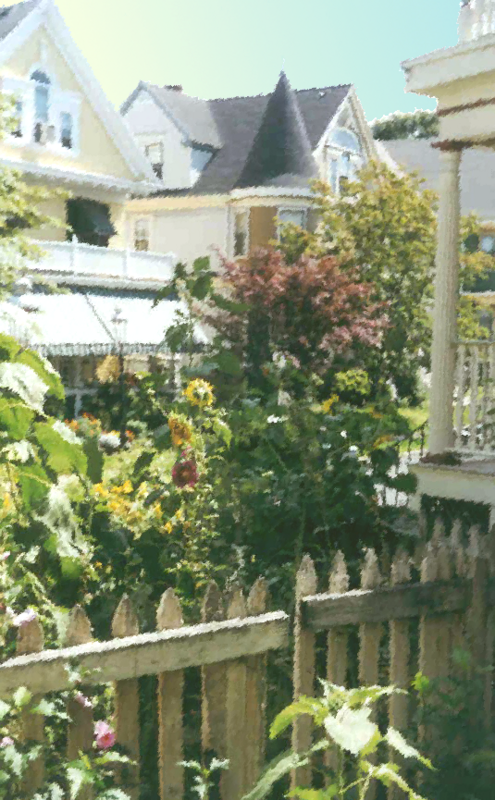
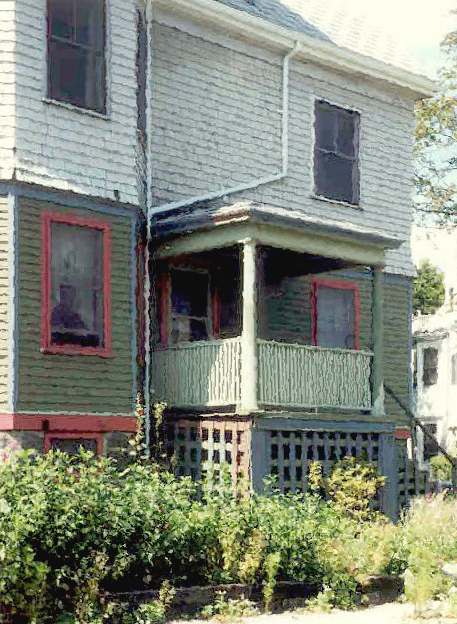
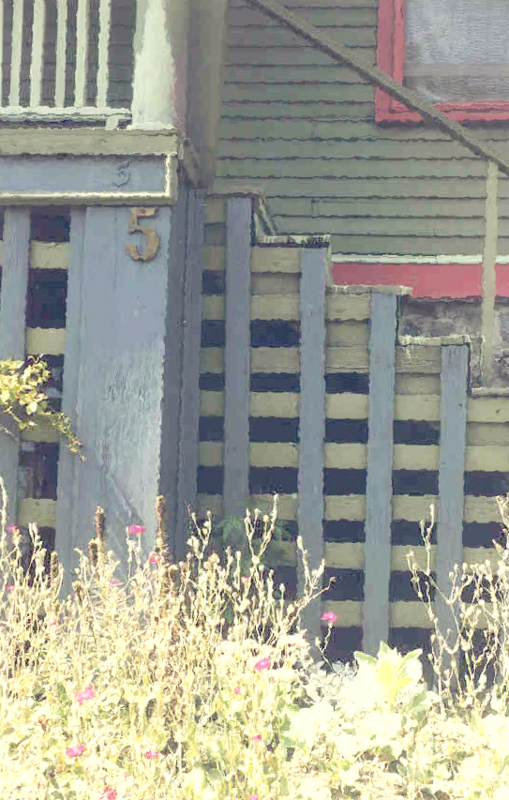
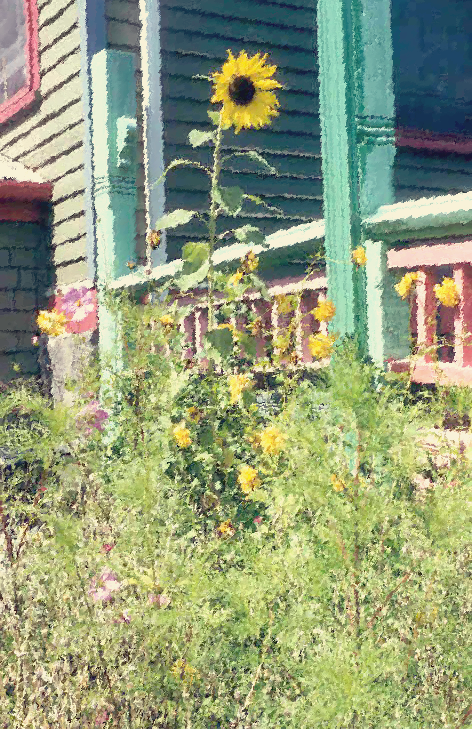
Here's Friday's version of the house at 67 Wellesley Park, Dorchester—still down the street from Nick's and still in better condition than his house! I fantasized this variation from a series of B&W photographs I took during summer 2000.

On a couple of my other blogs I've posted some old material; the following paragraphs are from a short-lived site I hosted during summer 2000 and so fun to remember and think about. I'm blogging the introduction here, and then posts on the three topics we actually developed, in topical order rather than jumbled according to date. In what used to be my almost usual social-scientist identity (whatever happened? It got outpaced by the theologian, I guess), I initiated the subjects we discussed.

A really really old one, spunoff some from our very first assignment when I decided to begin a second bachelor's degree. The course was introductory sociology; we got to go to the university library and choose an article from journals the professor had on reserve. Of course I had to choose something very urban: Society, v. 16 no. 6 pp. 4,6-7, September-October 1979
• New Mood Downtown: internet link
• Wolf Von Eckardt, New Mood Downtown
• Society: v. 16 no. 6 pages 4, 6-7 September-October 1979
This article is concentrated and conclusive regarding positive aspects of the current migration back into the cities as a place to live. Von Eckardt shows a tremendous amount of enthusiasm for city living. Reflecting on contemporary trends, he cites everything now [1979 for the article's date] happening in a most positive light, taking negatives exclusively from the 30 to 40 years preceding the back-to-city-living trend. Although the article is only three pages long and therefore limited in scope and depth, the author seems almost obsessively intent on proving his point and extending his own enthusiasm to the reader.
The essential thesis appears to be that use – or misuse – of architectural space is the prime humanizing or dehumanizing factor. Beginning with the fact of the physical return of people from suburbia to cities, and ending with the observation that it is people who are beginning to make their environment livable and workable, the writer lists a series of factors that contribute to the neglect and decay of the city:
In ages past I've posted versions of Main Street on two of my other blogs: this far by faith and suntreeriver. Although in the wake of yesterday's graduation from Design School I'll seriously be getting back to my theologian identity, I also want to write some new blogs for this site and revitalize some of my old blogs and other articles. Here's Main Street for suntreeriver verbatim:

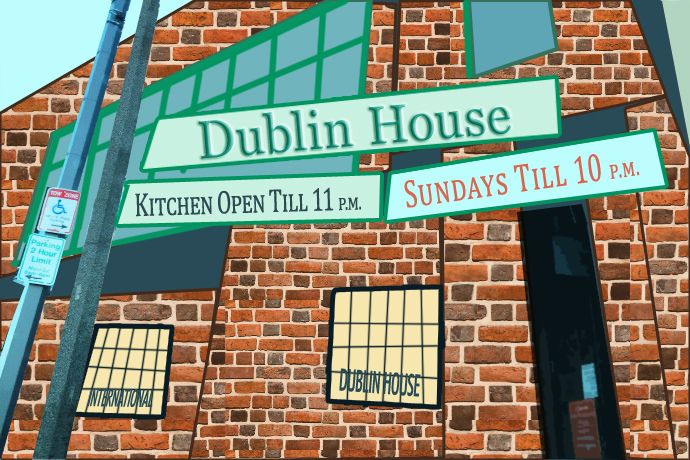
Another one! This takes us back to the same section of town in an earlier, simpler guise rather than in its later, increasingly sophisticated one:
This is not among my most sparkling literary achievements, but it portrays the neighborhood’s social location fairly well, though without any seriously sociological or anthropological commentary (no theological insights, either—after all, the weekly publication was not remotely church-related). With more protective changes of faces and places, in this review I’m still hiding the burden of guilt!Pete’s Eats and Sam’s II
Okay, all of you readers—since writing restaurant reviews for the local radical rag was probably my all-time favorite job anywhere at any time, I've decided to post a few more. These reviews are a indispensable part of my journeying this far by faith, but judiciously I've changed names, places, and some other specifics to continue protecting the guilty. As I chose my revisionist designations, I noticed how constantly I'm pulled back and forth between seacoast and desert. No surprise! But this time I stuck with the coast...