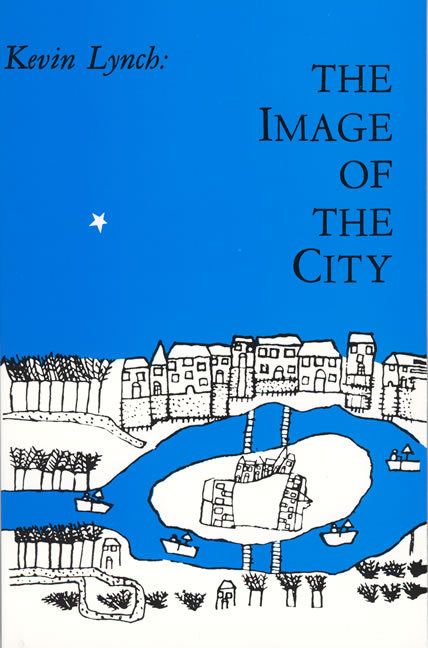
 The Legible City—a city you can read! As an iconographer writes rather than draws or paints an icon, a city comprised of colors, shapes, motion, and light can be viewed, read, and interpreted as an environmental image. The picture includes identity (what is it?), structure (space, shape, pattern relation and discrimination), and meaning (emotional, psychological, historical values) from the observer's own experiences. Each image derives from here and now; the city "image also is soaked in memories and meanings." [page 1] And, of course, there's not a single public image of any city, but a series of overlapping and interrelated ones.
From author Kevin Lynch: "This book is about the look of cities, and whether this look is of any importance, and whether it can be changed." This book is "a first word not a last word…" it's "at once tentative and presumptuous." The research method consisted of relatively objective systemic field reconnaissance and relatively subjective interviews with a small sample of mostly professional and managerial city residents. Citizens interviewed in Chapter 2, "Three cities," were exceedingly small samples: 30 in Boston, 15 each in Jersey City and Los Angeles, so these are not necessarily commonly held public images of those cities.
Kevin Lynch and his colleague Gyorgy Kepes researched and wrote this book during the 1950s; since then we've moved from Metropolitan Statistical Areas to a string of Megalopoleis (I found 3 possibilities for the plural of megalopolis and chose this one). At least two Boston features in the book no longer exist: Scollay Square, superseded by Government Center that includes City Hall of still controversial love it or hate it (I adore it) architectural design, and the Central Artery, replaced by the most expensive public works project in history: The Big Dig. But you will find physical structures of paths, edges, nodes, districts, and landmarks in any human population center larger than a village, so they're not necessarily an urban distinctive. "Districts are structured with nodes, defined by edges, penetrated by paths, and sprinkled with landmarks." [pages 48-49]
The five chapters include:
• The Images of the Environment
• Three Cities—Boston, Jersey City, Los Angeles. In each case, studies came from a small central area of 2.5 x 1.5 miles.
• The City Image and Its Elements
• City Form
• A New Scale
Appendices are sufficient to make another short book:
• Some References to Orientation
• The Use of the Method
• Two Examples of Analysis [Beacon Hill and (the late) Scollay Square, Boston]. There's also a bibliography and index. Margins throughout the book include many many line drawings and there are quite a few Black and White photographs.
In terms of future cities The Image of the City might influence, "We have an opportunity of forming our new city world into an imageable landscape: visible, coherent, and clear." By definition a city is multi-purpose with mixed functions yet with "fundamental functions of which the city forms may be expressive: circulation, major land-uses, key focal points. [pages 9-92] The common hopes and pleasures, the sense of community may be made flesh. Above all, if the environment is visibly organized and sharply identified… it will become a true place, remarkable and unmistakable."
As a handbook about present and about possibilities, "what we seek is not a final but an open-ended order, capable of continuous further developments" [page 8] The Image of the City "is about the look of cities, and whether this look is of any importance, and whether it can be changed," but appearance is an immeasurably critical part of the infrastructure that supports all the activities of the urban enterprise, the work, play, school, and home lives of the city's citizens. A city's physical appearance and the emotional responses that arise from it can be the reason someone wants to move there or the reason they long to leave. "The map, whether exact or not, must be good enough to get one home." [page 9]
Close to the end Kevin Lynch reminds us of Susanne Langer and gives us her definition of architecture: "the total environment made visible." Remember Langer's Philosophy in a New Key where she writes about our human need for symbols and our need to symbolize, to invent and invest meanings in objects, our environments, our activities, and our world?
These are shapes, spaces, and vistas that will – or won't – attract new artistic, educational, and commercial enterprises; no wonder this book is a classic! Kevin Lynch's prose is dryer than I'd prefer, but it is what it is, and if someone doesn't write like a poet, they don't. I'll give The Image of the City a high recommend to read and to read again.
my amazon review: the legible city